

Key takeaways
- Save a WeChat Channels talking-head video to the knowledge base, let it download to your computer, then click Decompose on it yourself. You get a topic, a structure template, shots, a per-shot shooting script and a timed transcript, and the transcript text, keyframes, shot MP4 clips and M4A music cues are copied to
decompositions/<title>in the asset library.- For talking-head videos, the timed transcript and the shot script are what to study: how long each line runs, where the pauses fall and when the picture cuts away are all in front of you. Once you see how it works, click AI rewrite and write your own script on its structure.
- Decomposition uses model quota, and rewriting uses the chat model. Music cues come from ranges with sound but no speech, so they may include ambient sound; this is not vocal separation. Rewriting learns structure and delivery; it doesn't copy the original's words.
Most talking-head videos on WeChat Channels are one person speaking to camera for two or three minutes: a personal story, three pieces of advice, one point to land on. It looks easy until you try it. How do you get people to stop scrolling in the first line? Which sentence needs a beat after it? When should the picture change? It all comes down to feel.
Learning from a well-delivered video used to mean pausing over and over and typing the lines out. In Beav, that becomes one Decompose. Every line becomes text with a timestamp, every shot gets a description, the whole video's flow becomes a structure template, and the results go to your asset library with their source attached. Saving is the first step of building a material library, breaking things down is the second, and writing your own script is the third.
Who it is for
- WeChat Channels creators doing explainers, local-life or career talks who want to see how similar accounts deliver.
- Community and private-traffic managers who need a good video's script turned into something the team can practice from.
- New creators who freeze in front of the camera and don't know how to organize a two-minute talk.
How to use it
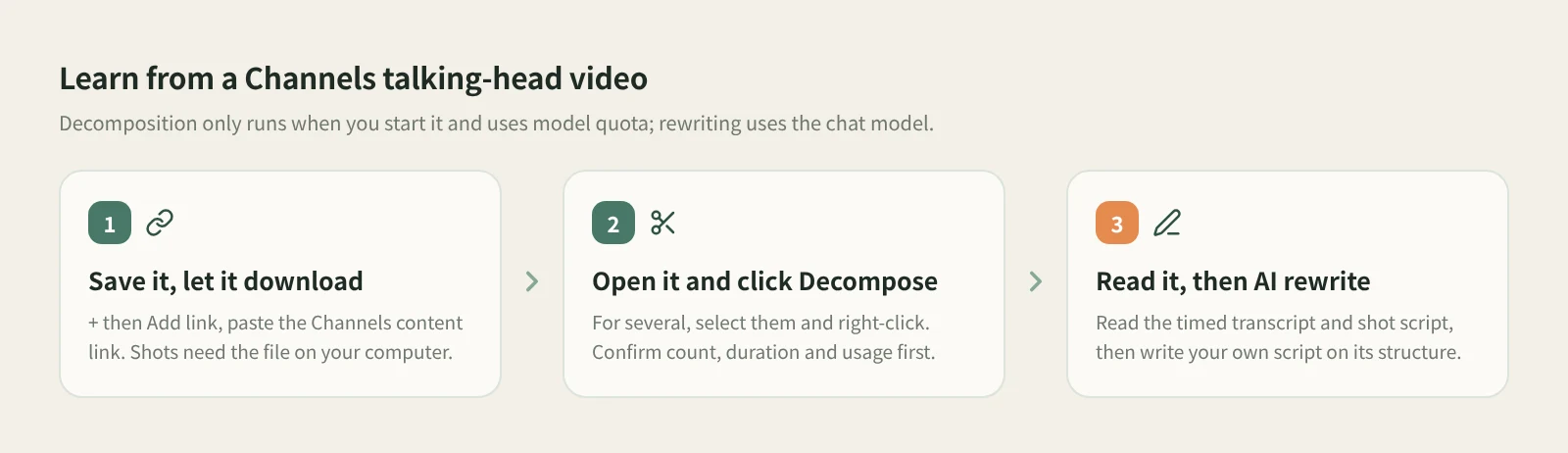
- Save the video first. In the knowledge base, click + next to Knowledge Base, choose Add link and paste a recognizable WeChat Channels content link or its share text. The walkthrough is in keeping good WeChat Channels videos from getting lost.
- Wait for it to download. While the card shows Downloading, there are no shots to cut yet. Cutting shots, making clips and pulling music all need the video on your computer.
- Open the item and click Decompose. To do several similar videos at once, select them in the list, open the context menu and confirm the item count, video duration and model usage before it starts. A batch takes up to 100 items.
- Read the transcript for rhythm. Click a shot thumbnail or timestamp and the video jumps there. If a cut is off, merge the shot into the previous one or split at the playback position; later runs keep your cuts.
- Click AI rewrite and write your own. Click AI rewrite at the top right of the item. Beav opens a new chat with a reference to this video and the rewriting skill selected. Add your brief and send it yourself.
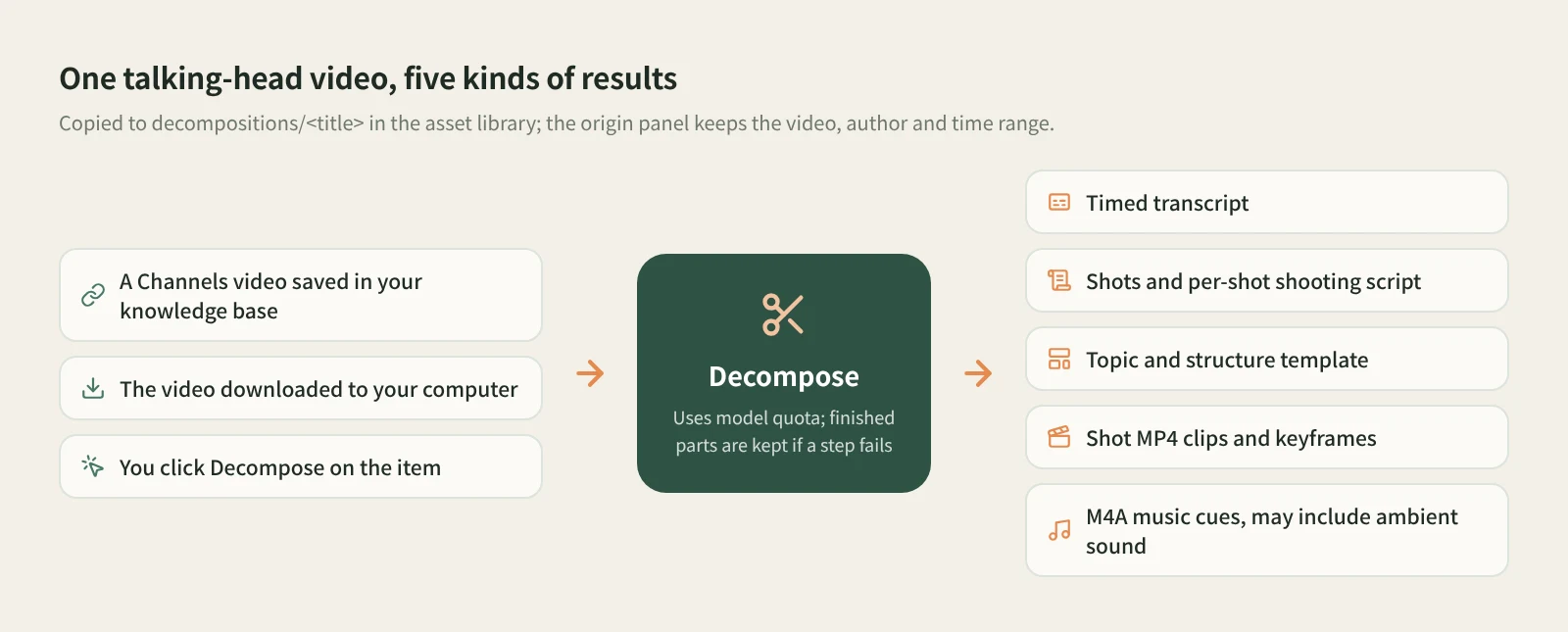
The timed transcript: the backbone of a talk. Every line the creator says becomes text with its own timestamp. Read it top to bottom and you see how long the opening line takes, where a sentence is unusually short and where one runs on. A lot of what makes a talk feel well-paced lives in those lengths.
Shots and the per-shot shooting script: which line gets a new picture. A talking-head video looks like one person speaking straight through, but it often cuts to a close-up, drops in an image or changes angle. The shooting script lists each shot in order, with what it shows and how it was filmed. Read it next to the transcript and you see which lines got a visual and which stretches the speaker carried alone.
Topic and structure template: what comes first. The structure template lays out how the video opens, develops and closes. The topic also goes to the topic center, where you can find it later.
Shot MP4 clips, keyframes and M4A music cues. The video is cut shot by shot, with an MP4 clip and a keyframe for each. Music cues come from ranges with sound but nobody talking. Talking-head videos have few of those, maybe just the intro and outro, and they may include ambient sound. Vocals and music are not separated, so listen before you use one.
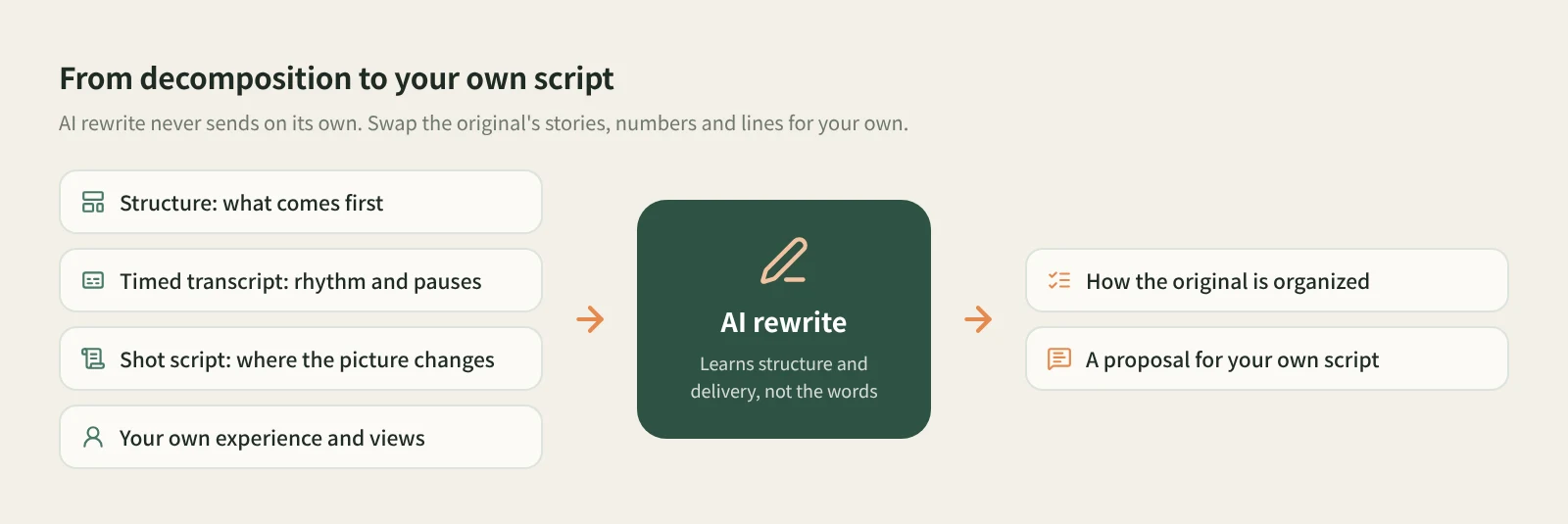
Writing your own script. When you rewrite, say what to keep and what to change. For example: "Keep the opening question and the 'one story plus three tips' structure, swap in what I learned from three years of running a neighborhood group-buying business, and keep it to two minutes." The assistant first explains how the original is put together, then proposes the new script. The stories, numbers and memorable lines in the original belong to someone else, so replace them with your own. More in AI rewriting that isn't just swapping words.
What uses quota? Saving a Channels video through Add link goes through the capture service, which needs sign-in or a configured capture API and consumes quota according to its rules. Decomposition then uses model quota: the transcript, topic and structure, and shooting script rely on transcription, chat and video-understanding models respectively. Rewriting uses the chat model.
How it compares with the usual ways
| Breaking it down by hand | CapCut auto captions | A separate music-ripping tool | Beav Decompose | |
|---|---|---|---|---|
| Strength | You hear every line yourself, so it sinks in deepest | Captions land on your timeline, great for captioning your own videos | Built for audio; some identify the song or separate vocals | Transcript, shot script, structure, clips and music in one run |
| What you get | Notes and screenshots | Caption text | An audio file | Topic, structure template, per-shot shooting script, timed transcript, shot MP4 clips, keyframes, M4A music cues |
| Source | You track it | Lives in the edit project | Usually you track it | Origin panel keeps the video, author and time range |
| Writing your own next | By hand | By hand | Not applicable | AI rewrite opens a chat with this video attached |
| Cost | Free, but slow | Per CapCut's own terms | Depends on the tool | Model quota |
If you want to build your own feel for talking to camera, breaking a video down by hand and reading the lines aloud a few times is still the surest way, and what Beav produces only counts once you've read it and judged it yourself. For captioning your own footage, CapCut is the smoother tool. If you need a song's name or a clean instrumental, a dedicated audio tool fits better: Beav doesn't identify songs or separate vocals. Beav is for breaking down a batch of similar talks, keeping them in a library you can trace back to the source, and moving straight on to writing.
Limits and notes
- The video has to be on your computer. Items still downloading, or whose download failed, can't produce shots, clips or music. Decomposition only runs when you start it; saving never starts one.
- If results are partial, read the reason. Check the reasons at the bottom of the result, the media download progress and your model setup. If one step fails, the finished parts are kept.
- Running it again won't overwrite your edits. Versions you changed in the asset library are kept, and changed outputs are saved as new copies. After you adjust cuts, decompose again to get new clips; old clips are not deleted. Shared spaces don't offer Decompose.
- AI rewrite never sends on its own, and Beav never posts for you. Writing, filming and publishing stay with you.
- What you break down is for your own study. Rewriting should learn structure and delivery, not lift lines or footage. Get the creator's permission before using clips, keyframes or music in anything you publish or sell.
Next steps
- For the full flow from saving to rewriting, read saving, breaking down and rewriting WeChat Channels videos.
- For how to make a rewrite your own, read AI rewriting that isn't just swapping words. For why collecting matters at all, read the series overview, "Accumulation Is the Moat".
- Full reference: decompose videos and notes.
Applies to Beav desktop 2.9. Checked 2026-11-03.