
Key takeaways
- Save a RedNote video post to the knowledge base, let the video finish downloading, then click Decompose on it. One run gives you four things: a per-shot shooting script (the script), shot cuts with MP4 clips (the shots), a timed transcript (the audio) and M4A music cues (the music), plus a topic and a structure template.
- Everything is copied to
decompositions/<title>in the asset library, and the origin panel keeps the source post, author and time range. If a cut is off, merge it into the previous shot or split at the playback position, then decompose again to get clips at the new cuts.- Decomposition only runs when you start it and uses model quota. Music cues come from ranges with sound but no speech, so they may include ambient sound; this is not vocal separation. Photo posts give a topic, structure and template only.
When a RedNote (Xiaohongshu) video is shot really well and you want to learn from it, you usually end up doing four jobs: noting what each shot shows, cutting clips to keep as reference, transcribing the voiceover line by line, and pulling out the background music. That's four tools, four folders, and a month later you can't tell which clip came from which video.
In Beav those four jobs are one Decompose. The script, clips, transcript and music all land in the asset library, and each piece remembers which post and which seconds it came from. Saving is the first step of building a material library. Breaking things down is the second: a good video stops being a bookmark and becomes parts you can pull into your next one.
Who it is for
- RedNote video creators who want to learn the shot rhythm and voiceover structure of benchmark videos.
- Directors and social media managers who hand shot lists and storyboards to a team.
- Anyone who wants to keep good clips and music as reference for their own edits.
How to use it
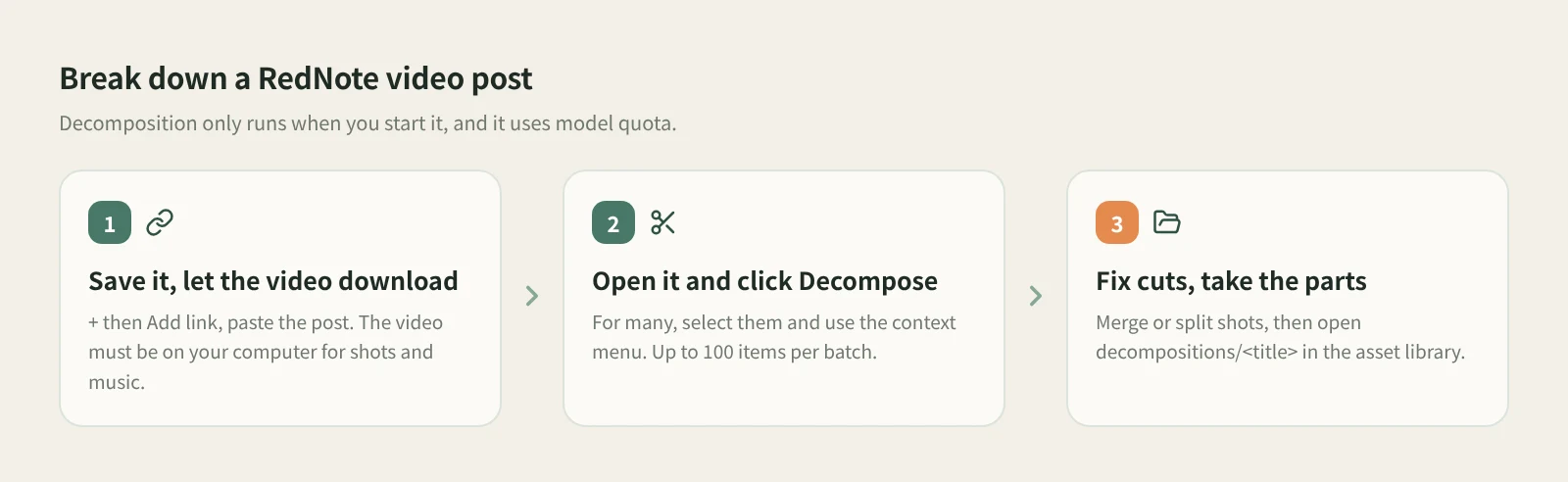
- Save the video post first. In the knowledge base, click + next to Knowledge Base, choose Add link and paste the post link or its share text. The full walkthrough is in saving RedNote posts to a reference library. Saving never starts a breakdown.
- Wait for the video to download. A card showing Downloading still has media coming in the background. The video has to be on your computer before Beav can cut shots, make clips or pull music.
- Open the item and click Decompose. For many videos, select them in the list, open the context menu and confirm the item count, video duration and model usage. A batch takes up to 100 items.
- Expand the result and check it against the video. Click a shot thumbnail or a timestamp and the video jumps there. If two shots are really one, merge it into the previous shot; if one shot hides a clear transition, play to that point and split there. Later runs keep your cuts.
- Take the parts from the asset library. Open
decompositions/<title>in the asset library for the transcript text, keyframes, shot MP4 clips and M4A music cues. The topic also goes to the topic center.
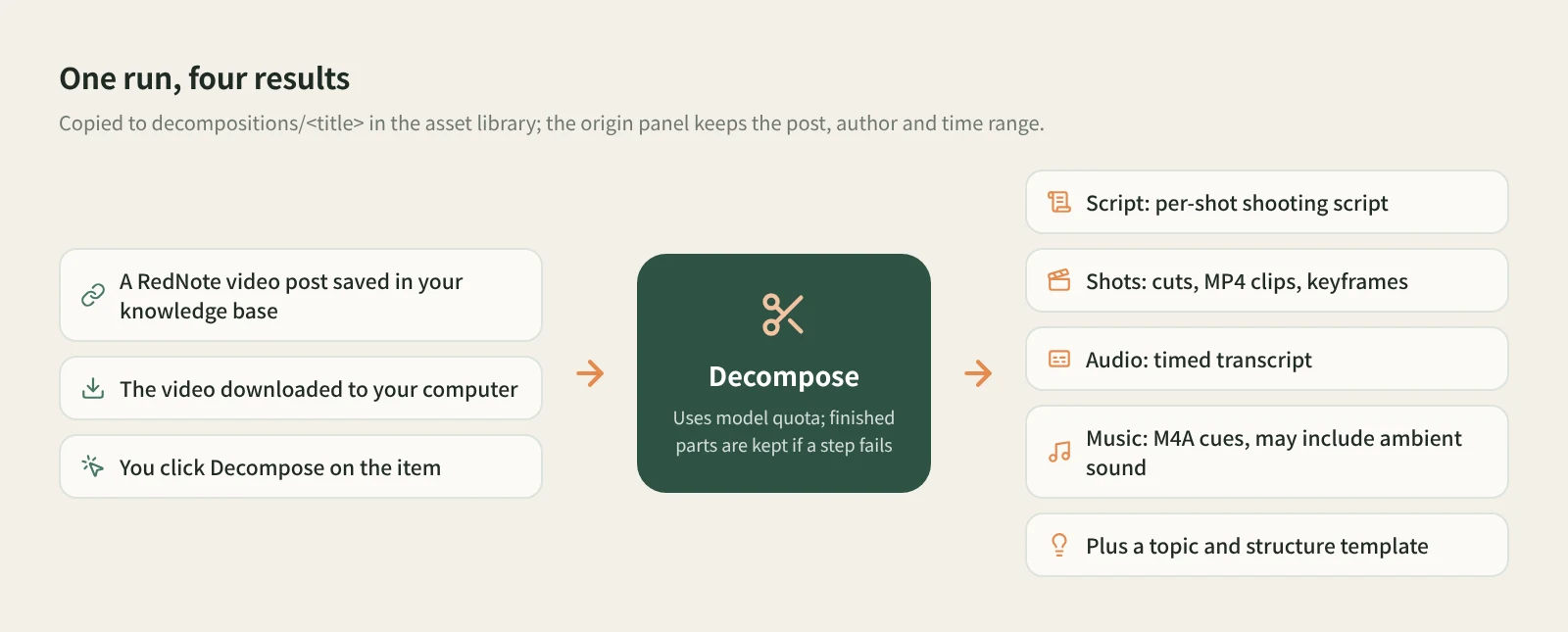
The script: a per-shot shooting script. What each shot shows and how it was filmed, in order. When you plan your own video you can build a shot list from it. You're learning how the shots are arranged, not remaking the video.
The shots: cuts and MP4 clips. The video is cut shot by shot, with an MP4 clip and a keyframe for each. Seeing exactly where a cut lands or where a close-up comes in is far clearer in a clip than in a description. After you adjust cuts, decompose again to generate new clips; the old clips are not deleted.
The audio: a timed transcript. Everything said in the video becomes text with a timestamp on each line, so you can see which line goes with which shot. For talking-head videos this is often the most useful piece.
The music: M4A cues. Beav takes the ranges where there is sound but no speech and saves them as M4A. They may include ambient sound, and this does not separate vocals from music. What you get is the sound the video uses between the talking.
Two more: a topic and a structure template. The topic is added to the topic center. The structure template shows how the video opens, where it turns and how it ends. Photo posts get only these and a template, with no shots or music.
What uses quota? Saving the post through Add link goes through the capture service, which consumes quota according to its rules. Decomposition then uses model quota: the transcript, topic and structure, and shooting script rely on transcription, chat and video-understanding models respectively.
How it compares with the usual ways
| Breaking it down by hand | CapCut auto captions | A separate music-ripping tool | Beav Decompose | |
|---|---|---|---|---|
| Strength | Deepest understanding; every call is your own | Captions land on your timeline, ready to edit | Built for audio; some identify the song or separate vocals | Script, shots, transcript and music in one run |
| Time | A long session per video | Quick once the video is imported | One video at a time | One click, then wait |
| What you get | Your notes and screenshots | Caption text | An audio file | Shot script, MP4 clips, keyframes, timed transcript, M4A music cues, topic, structure template |
| Source | You track it | Lives in the edit project | Usually you track it | Origin panel keeps the post, author and time range |
| Later use | Dig through notes | Used in that project | Sits in a folder | Find it in the asset library, drag it into a chat |
| Cost | Free, but slow | Per CapCut's own terms | Depends on the tool | Model quota |
Breaking a video down by hand is still the best way to really understand it, and you should look over what Beav produces and decide for yourself what makes the video work. For captioning your own footage, CapCut's auto captions are very convenient. If you need the song's name or a clean instrumental, a dedicated audio tool is the better fit: Beav doesn't identify songs or separate vocals. Beav is for breaking down many benchmark videos and building the results into a library you can search.
Limits and notes
- The video has to be on your computer. Items still downloading, or whose download failed, can't produce shots, clips or music.
- Results can be partial. Check the reasons at the bottom of the result, the media download progress and your model setup. If one step fails, the finished parts are kept. Video over the video-understanding size limit is first compressed to a low-resolution copy; if it's still too large, the shooting script is skipped and the reason is shown.
- Running it again won't overwrite your edits. Versions you changed in the asset library are kept, and changed outputs are saved as new copies. Shared spaces don't offer Decompose.
- What you break down is for your own study. Rewriting should learn structure and rhythm, not lift footage or lines. Get permission before publishing or commercial use of clips, keyframes or music.
Next steps
- To turn a broken-down post into your own photo post or video, read RedNote breakdown and rewriting.
- For more on video breakdowns, see how to break down a viral video. For why collecting matters at all, read the series overview, "Accumulation Is the Moat".
- Full reference: decompose videos and notes.
Applies to Beav desktop 2.9. Checked 2026-10-31.